Monday, 12 January 2015

The Untrained Artists - Exhibition curated by Heather Gibson (EPQ student)


For my Extended Project, I started to look specifically at Outsider Art (simply, art produced by untrained artists) and transgressed into the benefits of self-expression. After trawling through blogs, journals and art critiques I started to wonder whether or not self-expression through art was limited to trained artists.
I wanted to curate an exhibition of art from untrained artists to query this. To discuss how beneficial creativity is in terms of self expression, I wanted to interview each person to measure how each person felt before and after drawing. With the untrained view on art as my focus for my EPQ, discussion was key in both my exhibition and catalogue.
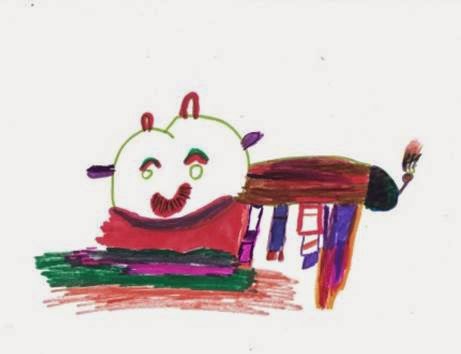
 I approached LoddonSocial Enterprise and asked several service users to draw me a picture based on a prompt. I gave each person a selection of prompts so that their style could emerge. The prompts I used were “Patterns” “Home” “Friends” “Animals” and “Your Favourite thing”.
Though I wanted to interview each participant about the process to measure the psychological benefits of self expression, I soon realised that anonymity would strengthen the case for Outsider Art and the untrained view. Rather than focusing on any one piece, the viewer would have to regard all of the work as a whole, hopefully resulting in contemplation. Though I didn’t go through with the full interviews, I did ask for a sentence explaining the choice of prompts and what they had created as a response.  - Heather Gibson, January 2015.
 
A selection from the exhibition:
Patterns:
"It's what came to mind"
 

"She did patterns because she enjoys doing them"


Home:
"This is my house"

"It's my choice to draw my house"


Friends:
 

"I enjoy watching and playing football with my friends"

"It's a picture of my friend Santa"


Animals:
"I love animals"

"It's my dog"

Your Favourite Thing:
"PS4 just came into my head and it was easy to draw"

"I drew him because I enjoy all the films. I enjoy drawing heroes"


Monday, 10 November 2014

AS Photography & A2 Textiles Exhibition


AS PHOTOGRAPHY

At the beginning of the AS Photography course, before learning about all the different functions on film and digital cameras and how to use them creatively, the students first make and use a pinhole camera.

A pinhole camera is a darkened box, into which light is introduced through a tiny aperture, uncorrected by a lens. In this case, the students used an empty drinks can, but pinhole photographs can be made with anything light tight, from a mouth to a pumpkin, from a room to a moving van. They are based on the principles of a Camera Obscura, used by artists for centuries, but with photo-sensitive materials introduced.

This is photography in its purest form; a light-proof container, a small hole and some photo-sensitive material. As such, the results are reminiscent of some of the earliest photography. In more conventional photography, subjects take place in an orderly space. In contrast, the pinhole process causes subjects to blend with the spaces, creating distortions. This gives the image an eerie quality.

As a photographer, with pinhole photography, you are in control of the whole process from making the camera to what you photograph and how. By starting with pinhole, students learn how cameras work, and therefore how to use them as a tool for making creative work.


A2 TEXTILES

As part of the experimental stage for Unit 3, the A2 students were introduced to the process of screen printing to develop their ‘Design Eras’ project. The project has evolved from the student’s own research into a period of design from c.1850-1980. This has resulted in the diverse range of responses you see in the exhibition.

These are final pieces for this part of the project selected by each student from a variety of prints made on different fabrics and combined with other surface patterning techniques. Some pieces include layered designs utilising dye, batik, stitch or mono-prints to add colour and texture. Others simply explore the layering of different colour prints.

Following their experiments into surface pattern and constructed textiles, the students will develop their most successful ideas and choice of media towards an ambitious final outcome.  This can take any form from within fine art textiles, fashion textiles or textiles for interiors.